
Building Contractors in Shivamogga: Rates, Red Flags and How to Choose (2026)
Choosing building contractors in Shivamogga? 2026 rates for labour, turnkey and supervision, how to compare quotes line by line, red flags and questions to ask.

Table of Contents
- 01.The Four Types of Building Contractors in Shivamogga
- 02.Building Contractor Rates in Shivamogga for 2026
- 03.Labour-only rates
- 04.Turnkey rates
- 05.Why Two Quotes for the "Same" House Differ by ₹8 Lakh
- 06.The measurement trap
- 07.Red Flags When Hiring Building Contractors in Shivamogga
- 08.How to Check a Contractor in Five Steps
- 09.Step 1: Shortlist on fit, not on price
- 010.Step 2: Visit an ongoing site unannounced
- 011.Step 3: Visit a completed house that has seen two monsoons
- 012.Step 4: Ask for a line-item BOQ
- 013.Step 5: Read the agreement before the bhoomi pooja
- 014.Questions to Ask, and What a Good Answer Sounds Like
- 015.A Fair Payment Schedule
- 016.Agreement Clauses You Should Not Skip
- 017.Building Contractors in Shivamogga: What Is Different Here
- 018.Monsoon planning
- 019.Waterproofing is not optional
- 020.Approvals depend on where your plot sits
- 021.Materials and soil
- 022.Labour availability
- 023.Turnkey, Labour Contract or Supervision: A Simple Decision Rule
- 024.Getting a Like-for-Like Quote in Shivamogga
If you are searching for building contractors in Shivamogga, you will quickly find three very different kinds of people quoting for the same house: labour contractors (mestris) who supply masons and helpers, local contractors who supply labour plus some materials, and turnkey companies that deliver the finished home at a fixed per-sqft rate. In 2026, labour-only contracts in Shivamogga typically run about ₹280–340 per sqft, while turnkey rates usually sit somewhere between ₹1,800 and ₹2,800 per sqft depending on specification.
The per-sqft number is the least useful thing to compare. What matters is what is inside it, who carries the risk when something goes wrong, and whether the contractor can show you proof of the work they say they do. This guide is how our engineers would advise a friend in Shimoga who is about to hand over ₹40–60 lakh to someone they met three weeks ago.
The Four Types of Building Contractors in Shivamogga
Before you compare quotes, know which kind of contractor you are talking to. They are not competing for the same job, even if they say they are.
| Type | What they supply | Who buys materials | Who manages trades | Typical 2026 rate (approx.) |
|---|---|---|---|---|
| Labour contractor (mestri) | Masons, helpers, sometimes centering | You | Mostly you | ₹280–340/sqft (full labour) |
| Material-plus-labour local contractor | Labour plus cement, steel, sand, blocks; finishes often "owner supply" | Shared | Contractor, loosely | Highly variable, often ₹1,500–2,100/sqft for partial scope |
| Turnkey construction company | Everything to an agreed spec, design coordination, approvals support | Contractor | Contractor | Roughly ₹1,800–2,800/sqft |
| Supervision / PMC engineer | Inspection, quality checks, billing verification | You | You, with guidance | Custom quotes; varies by scope |
Each of these can produce a good house. Each also fails in predictable ways:
- Labour contracts fail when the owner cannot be on site. Cement gets used before steel is checked, plaster goes up before conduits are in, and wastage quietly eats 5–8% of the material budget.
- Material-plus-labour contracts fail at the boundary. The contractor supplies "steel", you supply "tiles", and nobody owns the waterproofing between them.
- Turnkey contracts fail when the specification is vague. A low rate with no brand names is not a fixed price; it is an opening bid.
- Supervision-only fails when the engineer visits once a fortnight and signs whatever he is shown.
If you want the deeper trade-off between the last two models, we have written a full comparison of turnkey vs supervision construction.
Building Contractor Rates in Shivamogga for 2026
These are working ranges, not quotes. Rates move with season (Malnad monsoon squeezes outdoor work), with the pre-Deepavali rush, and with the specification.
Labour-only rates
For owners running their own build, labour in Shivamogga is typically quoted per sqft of built-up area:
| Scope | Approximate rate |
|---|---|
| Full residential labour contract | ₹280–340/sqft |
| Structure only (RCC + masonry) | ₹180–220/sqft |
| Finishing only (plaster, flooring, paint) | ₹110–140/sqft |
On a 30×40 G+1 of about 2,100 sqft, full labour is roughly ₹5.9–7.1 lakh. Materials on top of that typically land in the ₹26–31 lakh range for a standard specification, before wastage. Day rates for individual trades (masons, bar benders, centering carpenters) vary through the year, so ask for the per-sqft and per-item rates in writing.
Turnkey rates
Turnkey quotes in the Shivamogga market spread widely. A rough way to read them:
- Below about ₹1,800/sqft: almost always a basic specification with low allowances for tiles, doors and fittings, or a quote that leaves out items you will assume are included (staircase finish, waterproofing, sump, parking floor).
- ₹1,900–2,300/sqft: the range where most family homes in Shivamogga are built with reasonable brands.
- ₹2,400/sqft and above: higher floor heights, premium flooring, UPVC windows, better paints and larger allowances.
For reference, our own Shivamogga turnkey packages in 2026 are:
| Package | Concrete blocks | Red bricks |
|---|---|---|
| Foundation | ₹1,995/sqft | ₹2,095/sqft |
| Signature | ₹2,250/sqft | ₹2,350/sqft |
| Prestige | ₹2,490/sqft | ₹2,590/sqft |
| Lux | ₹2,685/sqft | ₹2,785/sqft |
| Bare shell, Standard | ₹1,380/sqft | ₹1,480/sqft |
| Bare shell, Premium | ₹1,480/sqft | ₹1,580/sqft |
The architectural design fee is charged separately and is not part of these per-sqft rates. The full inclusions for each are on our packages page. We show these not to sell a package in a contractor-comparison article, but because a published rate card with named inclusions is exactly what you should ask every contractor for.
Why Two Quotes for the "Same" House Differ by ₹8 Lakh
This is the most common confusion we see. A family in Shivamogga gets two quotes for a 30×40 G+1: one at ₹1,750/sqft, one at ₹2,100/sqft. On 2,100 sqft that is a gap of about ₹7.35 lakh. They assume the cheaper contractor is more efficient. Usually he is quoting a different house.
Here is a worked comparison of the items that typically sit behind that gap. The figures are illustrative market ranges, not a quote.
| Line item | Quote A (₹1,750/sqft) | Quote B (₹2,100/sqft) | Approx. impact on a 2,100 sqft G+1 |
|---|---|---|---|
| Floor-to-floor height | 10'0" | 10'6" | More masonry, plaster and paint: ₹0.6–1 lakh |
| Steel | "ISI TMT" (no brand) | Named Fe 550D brand | ₹0.5–1.2 lakh |
| Concrete | "As required" | M20 for slabs, beams, columns, stated | Hard to price, easy to cut |
| Vitrified tiles | ₹40/sqft allowance | ₹65/sqft allowance | ₹0.5–0.8 lakh |
| Main door | "Teak frame" | Teak frame and shutter, value stated | ₹0.2–0.4 lakh |
| Windows | MS grill + wooden | UPVC or aluminium, stated | ₹0.6–1.5 lakh |
| Staircase | Plain concrete | Granite treads and risers | ₹0.6–1 lakh |
| Terrace waterproofing | Not mentioned | Included with method | ₹0.4–0.8 lakh |
| Sump and overhead tank | Not mentioned | RCC sump, stated capacity | ₹0.8–1.5 lakh |
| Parking and terrace tiling | Not mentioned | Included | ₹0.6–1 lakh |
| Electrical points | "As per drawing" | Count per room stated | ₹0.3–0.8 lakh |
Add up the right-hand column and most of the "efficiency" disappears. Some of it comes back as extras halfway through the build, when you are in no position to negotiate.
The measurement trap
Ask every contractor one question: how do you measure the built-up area you are charging for? Some include balconies, portico, sunshades, staircase headroom and parapet walls at full rate. Some at half rate. Some exclude them. On the same drawing, the billable area can differ by 8–12%.
A ₹1,950/sqft quote on 2,350 "measured" sqft costs more than a ₹2,050/sqft quote on 2,100 sqft. Get the method in writing, with the area calculation attached to the drawings.
Red Flags When Hiring Building Contractors in Shivamogga
None of these alone proves a contractor is bad. Two or three together should make you walk away.
- No written specification. A rate without a brand list is not a fixed price.
- Pressure to start before plan sanction. Construction without approval exposes you, not the contractor, to notices and loan problems.
- Large advance. A request for 25–30% upfront "to book material" is a cash-flow problem being moved onto you.
- No ongoing site you can visit. Photos on WhatsApp are not a reference. A contractor who is working should have a site you can walk into this week.
- Only new completed houses to show. A house completed three months ago has not seen a monsoon. Ask for one that has been through two.
- "We don't need a structural drawing for G+1." You do. Column sizes and steel should come from a structural engineer, not from habit.
- Cash-only billing with no receipts. You will need records for a home loan, for tax, and for any dispute.
- No mention of curing. Ask how long slabs and walls are cured and who does it on Sundays.
- Vague timeline. "Around a year" is not a timeline. Stages with target months are.
- Everything is "extra later". If the quote lists more exclusions than inclusions, the real price is unknown.
- No defect or warranty terms. Ask what happens if the terrace leaks in the second monsoon.
- They criticise every other contractor but cannot explain their own process. Confidence is cheap; a written quality checklist is not.
How to Check a Contractor in Five Steps
Step 1: Shortlist on fit, not on price
Shortlist three contractors who regularly build the size and type of house you want. A contractor who mostly does commercial godowns, or one who mostly does small repairs, is not automatically right for a G+1 family home.
Step 2: Visit an ongoing site unannounced
This is where you learn the most. Go mid-morning on a weekday and look for:
- Cement bags stacked on a raised platform, covered, not on wet ground.
- Steel stored off the ground, not rusting in a puddle.
- Cover blocks under the slab and column reinforcement (small concrete spacers that keep steel away from the formwork). No cover blocks means corroding steel in 15 years.
- Column alignment. Stand at one corner and sight along a row of columns. They should be straight and plumb.
- Curing. Fresh slabs should be ponded with water or covered with wet gunny bags. Walls should be wet.
- A drawing on site. Masons working without a printed drawing are working from memory.
- Site safety basics. Scaffolding that looks stable, no loose wiring lying in water.
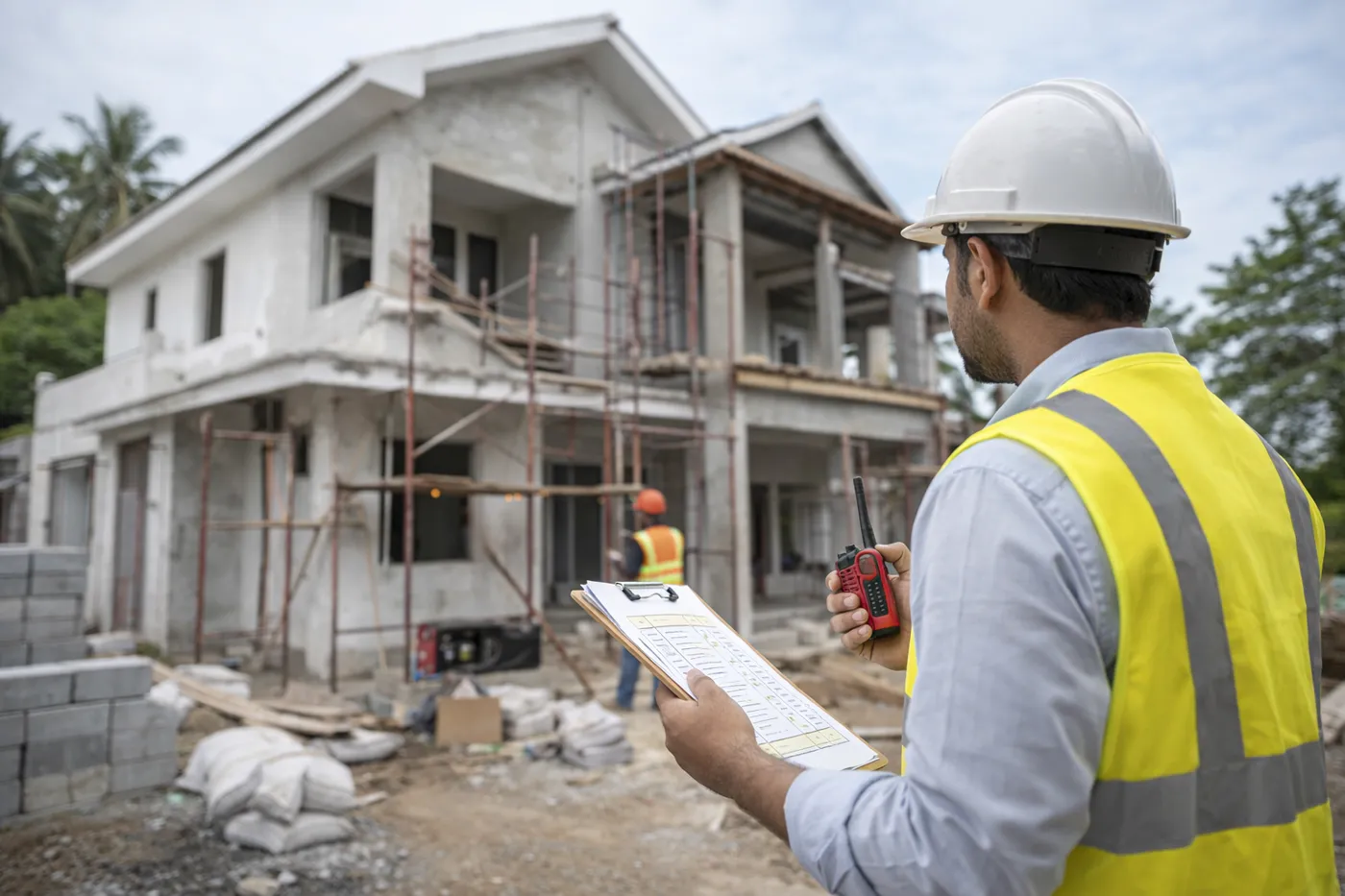 Illustrative site inspection during construction
Step 3: Visit a completed house that has seen two monsoons
Ask the owner directly: any terrace leaks, wall dampness, cracks over doors and windows, sticking doors, low water pressure upstairs? In Malnad weather, a house shows its quality on its first two monsoons. Look at the parapet top, the junction of the terrace and the staircase headroom, and the bathroom walls on the outside.
Step 4: Ask for a line-item BOQ
A bill of quantities lists every item with quantity, unit and rate or brand. It is the only way to compare quotes fairly. If a contractor refuses to give one, ask why.
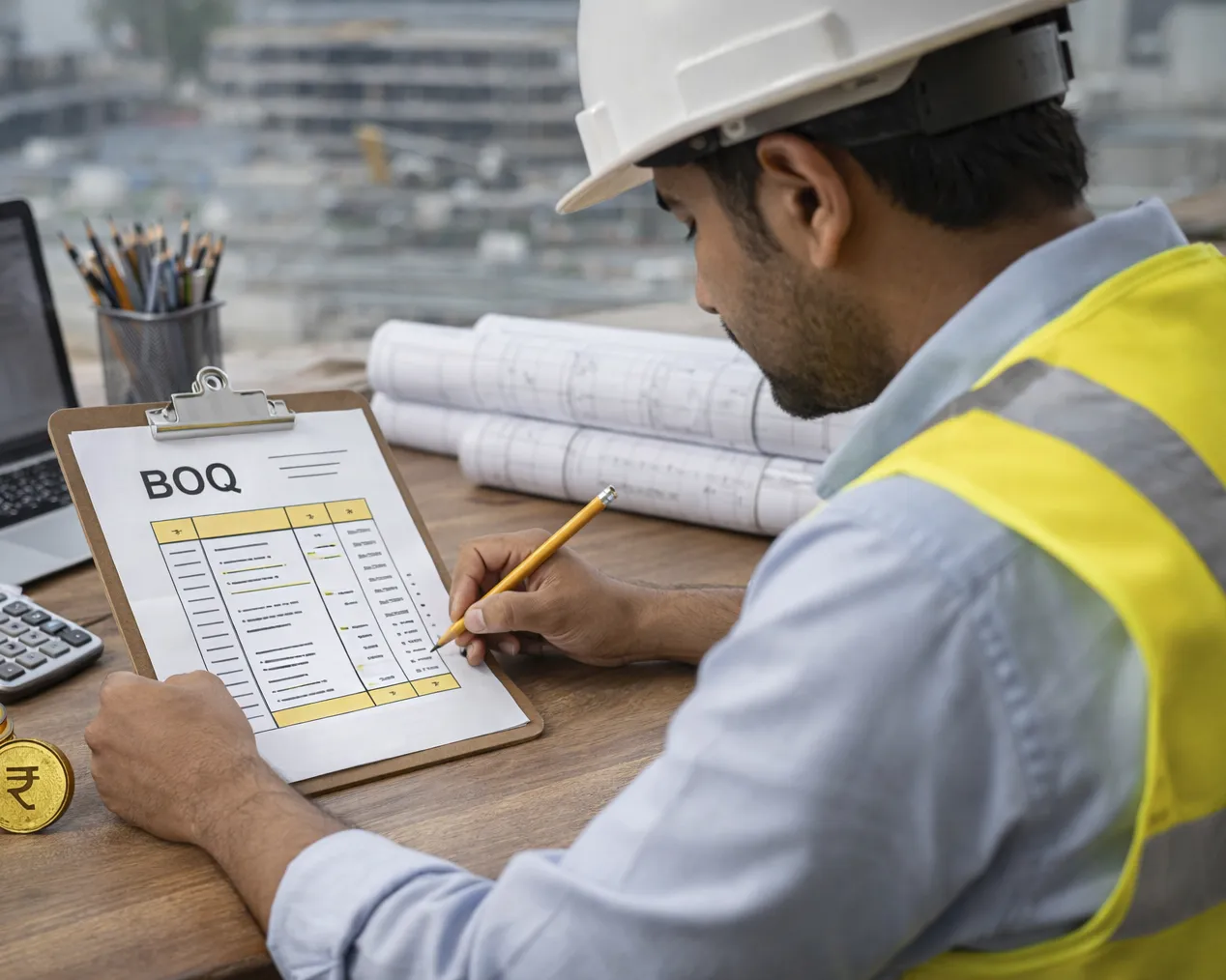 Illustrative BOQ preparation
Step 5: Read the agreement before the bhoomi pooja
Not after. Our construction agreement checklist lists the clauses worth checking; the essentials are below.
Questions to Ask, and What a Good Answer Sounds Like
| Question | Good answer | Worrying answer |
|---|---|---|
| Who prepares the structural drawing? | A named structural engineer; drawing shared before work starts | "Our mestri has 20 years' experience" |
| What concrete grade for slabs and columns? | M20 or higher, stated in the contract, with how it is mixed | "Normal mix" |
| How do you check steel before the slab pour? | Engineer checks bar sizes, spacing, laps, cover blocks against drawing; owner can attend | "We check" |
| How long do you cure slabs? | A defined period, with ponding or wet covering, and who is responsible | "Until it is set" |
| How are extras priced? | Written rate list or BOQ rate, approved before work | "We will see later" |
| What is excluded? | A clear list: design fee, approvals, compound wall, borewell, interiors, etc. | Silence |
| What happens if the terrace leaks? | Written defect liability and warranty terms | "That won't happen" |
| Who handles plan sanction and MESCOM connection? | Clear split of responsibility and fees | "You do it" or "We will manage" with no detail |
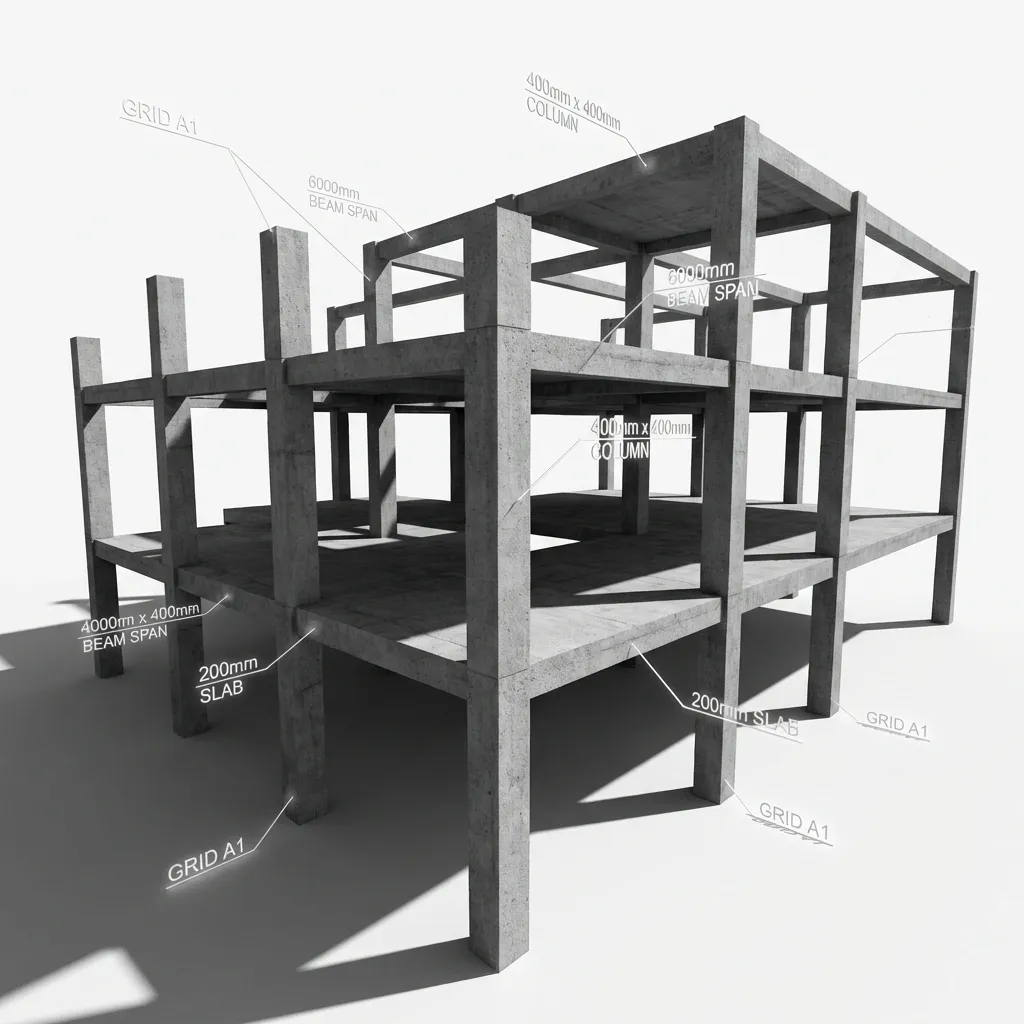 Illustrative RCC frame: columns, beams and slabs
A Fair Payment Schedule
Payments should follow work you can see. A typical stage-wise schedule for a G+1 might look like this (percentages are illustrative; every contract differs):
| Stage | Approx. share |
|---|---|
| Booking / agreement | 5–10% |
| Foundation complete | 10–15% |
| Plinth beam and plinth filling | 10% |
| Ground floor roof slab | 15% |
| First floor roof slab | 15% |
| Masonry complete | 10% |
| Plastering, electrical and plumbing conduits | 10% |
| Flooring, doors, windows | 10% |
| Painting, fittings and handover | 5–10% |
Two rules matter more than the exact percentages:
- Never pay for a stage before it is complete and checked.
- Keep a small retention until handover snags are closed.
If you are building with a home loan, align these stages with the bank's disbursement stages before you sign, so you are never asked to pay a stage the bank has not yet released.
Agreement Clauses You Should Not Skip
- Drawings and specification as annexures. The agreement should reference the exact drawing set and a material list with brands and grades.
- Area measurement method. Spelled out, with a sample calculation.
- Timeline by stage, with what happens if either side causes delay (including delayed payments from the owner, to be fair to both sides).
- Rain and force majeure. In Shivamogga, a clause that pretends the monsoon does not exist will be broken by July. A realistic one plans around it.
- Variations. Any change in design or specification priced in writing before work.
- Material substitution. Only with written owner approval and equal or better grade.
- Defect liability and structural warranty, with duration and what is covered.
- Approvals and utilities. Who files plan sanction, who pays fees, who arranges temporary and permanent electricity and water connections.
- Exit terms. How work is measured and settled if either side ends the contract.
Building Contractors in Shivamogga: What Is Different Here
A contractor who builds well in Bengaluru or Davanagere does not automatically build well in Shivamogga. A few local realities separate those who know the district from those who do not.
Monsoon planning
Shivamogga sits at the edge of the Malnad belt. The city itself gets a strong monsoon, and towns to the west such as Sagar, Thirthahalli and Hosanagara get considerably more. A contractor should be able to tell you, for your start month, which stages will fall in the monsoon and how they will protect them. Foundations and plinth are best completed before the heavy rain sets in; roof slabs ideally poured in drier spells, with proper curing. Our monsoon scheduling guide has month-by-month detail.
Waterproofing is not optional
In this climate, terrace waterproofing, sloped screeds to drains, drip grooves on sunshades and properly detailed bathroom waterproofing are basic items, not upgrades. If a quote treats them as extras, add their cost before comparing.
Approvals depend on where your plot sits
Inside city limits, plan sanction is with Shivamogga Mahanagara Palike (City Corporation). Layouts developed under the urban development authority (SUDA) have their own layout approvals, and plots in villages outside the corporation boundary typically go through the gram panchayat with e-khata records, often after land conversion. A contractor who says "approval is just a formality" has either not done many or is not planning to do yours. Our SMC building permit guide walks through the city process; always confirm current requirements with the authority.
Materials and soil
Most new homes in and around Shivamogga use M-sand for concrete and plaster, with river sand availability varying. Solid concrete blocks and red bricks are both common; laterite stone appears more as you move west. Soil varies from firm red and lateritic ground to clayey pockets and low-lying fills near the Tunga. A contractor who quotes a foundation without seeing the site, or without suggesting a soil check where the ground is doubtful, is guessing.
Labour availability
Skilled labour in Shivamogga tightens during the monsoon and before festivals. Ask contractors whether their core team (mason, bar bender, centering carpenter) is permanent or hired job by job. A permanent team is not a guarantee, but it is a good sign.
Turnkey, Labour Contract or Supervision: A Simple Decision Rule
Answer three questions honestly:
- Can someone in the family be on site most working days for 12–15 months?
- Does that person know what correct steel spacing, cover, curing and plaster thickness look like?
- Do you have reliable suppliers for cement, steel, sand, tiles and fittings, with credit terms and delivery you trust?
- Three yes answers: a labour contract with a good mestri can work, and may save some money. Consider adding periodic independent inspection.
- One or two yes answers: a labour or local contract plus a supervision engineer is the middle path.
- No yes answers: turnkey with a detailed specification is usually the safer choice, and often not much more expensive once wastage, rework and your own time are counted.
Whatever you choose, the protection is the same: written specification, stage-wise payments, independent checks at the stages you cannot undo (foundation, steel before every slab pour, waterproofing before tiling), and a contractor with houses you can actually visit.
Getting a Like-for-Like Quote in Shivamogga
If you are comparing building contractors in Shivamogga, use our rate card and inclusions as a benchmark sheet, even if you build with someone else. The cost estimator gives a quick figure for your plot size and floor count, and our Shivamogga construction service page lists what our turnkey scope covers.
If you would like an itemised quote or a site visit to talk through your plot, request a free estimate or call us on 080 4736 1818. Our engineers will go through the specification line by line, which is the conversation you should be having with every contractor on your shortlist.
Building in Shivamogga?
Get a professional, zero-jargon estimate from our local experts in Shivamogga or Davanagere. No hidden costs.
Get Free Personalized EstimateFrequently Asked Questions
How much do building contractors in Shivamogga charge per sqft in 2026?
A labour-only contract in Shivamogga typically runs about ₹280–340 per sqft, with the owner buying all materials. Turnkey contracts that include materials usually fall between roughly ₹1,800 and ₹2,800 per sqft depending on specification. Sturdy Groups' turnkey packages in Shivamogga start at ₹1,995 per sqft with concrete blocks; the architectural design fee is charged separately.
What is the difference between a labour contractor and a turnkey contractor?
A labour contractor (often called a mestri) supplies masons and helpers while you buy cement, steel, sand, tiles and fittings and coordinate the trades. A turnkey contractor supplies both labour and materials to an agreed specification at a fixed rate and manages the whole build. Turnkey costs more on paper but moves wastage, scheduling and rework risk to the contractor.
Why do two contractor quotes for the same house differ by several lakhs?
Usually because they are not quoting the same house. Differences in floor height, steel and cement brands, concrete grade, tile and door allowances, window type, waterproofing, staircase finish and how built-up area is measured can easily add up to ₹5–10 lakh on a G+1. Compare quotes line by line against one specification sheet before comparing the per-sqft figure.
How much advance should I pay a building contractor?
A modest booking advance, commonly in the range of 5–10% of the contract value, is normal. After that, payments should be tied to completed stages such as foundation, plinth, each roof slab, masonry, plastering and finishing. Avoid any arrangement where you pay for work well ahead of what is visible on site.
Who gets the building plan approval in Shivamogga, the owner or the contractor?
The application is made in the owner's name, but a good contractor or architect prepares the drawings and handles the filing with Shivamogga Mahanagara Palike or the relevant authority. Your contract should state clearly who is responsible for approvals, who pays the fees, and that work will not start before sanction.
Is it better to hire a local mestri or a construction company in Shivamogga?
A capable local mestri can deliver a good house if you have time to be on site, construction knowledge and reliable material suppliers. If you work full-time, live away from Shivamogga or want a fixed price and a structural warranty, a turnkey company or at least an independent supervision engineer is usually the safer choice.
What should be included in a construction agreement in Shivamogga?
At minimum: drawings and specification sheet as annexures, brands and grades of materials, the method of measuring built-up area, a stage-wise payment schedule, timeline with a defined handover, how extra work is priced, defect liability and warranty terms, and who handles approvals and utility connections.
Ready to build?
Download the 2026 Construction Price Guide to plan your finances with 99% precision for projects in Karnataka.
Written by
Sukruth Harish
Founder & CEO, Sturdy Groups at Sturdy Groups · 8+ Years in Karnataka Construction